

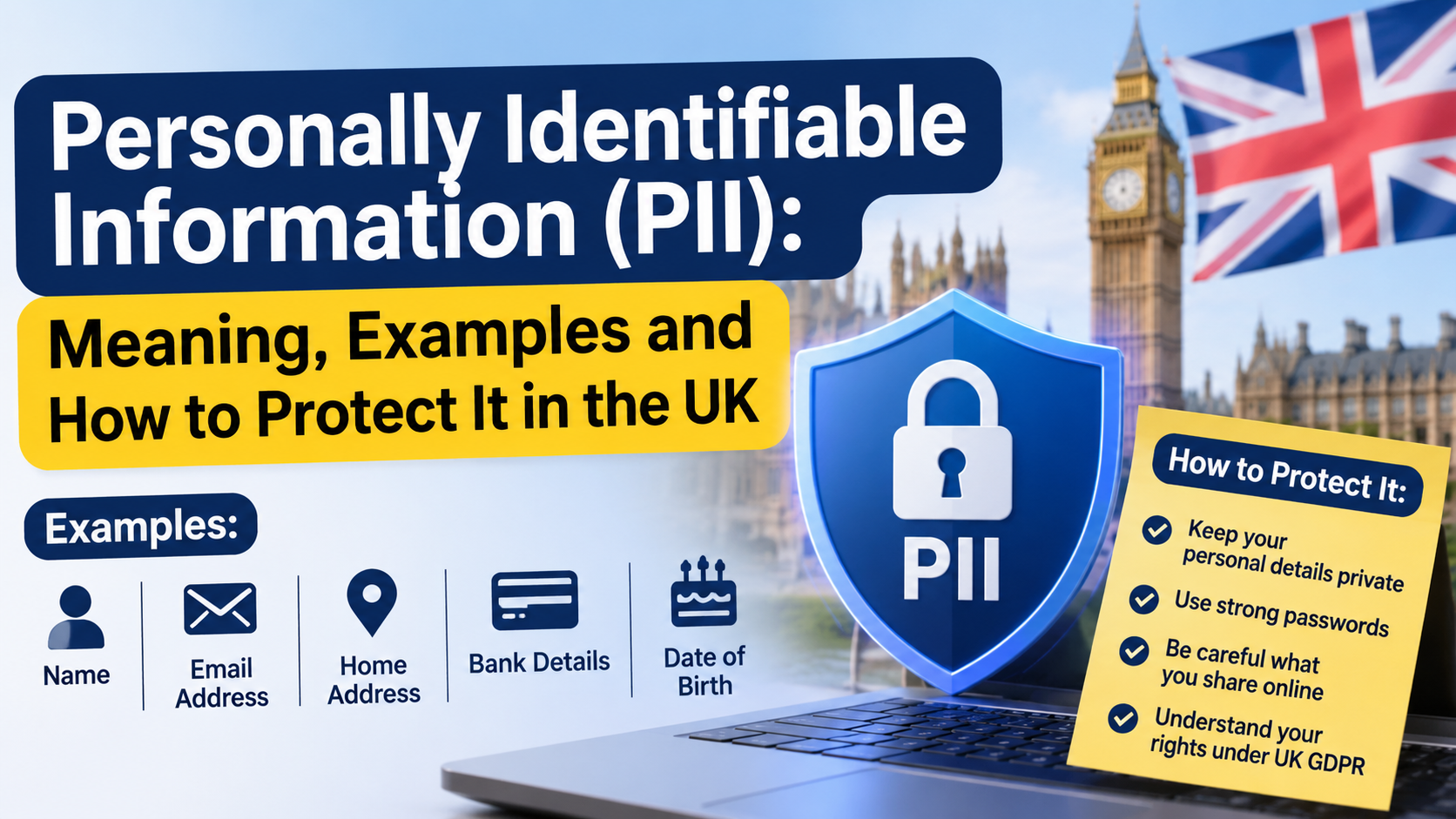
Personally Identifiable Information (PII) plays an important role in protecting individual privacy and preventing identity theft. Every day, businesses collect personal details through websites, online forms, customer accounts, emails and payment systems. However, failing to protect this information can expose individuals to fraud, data breaches and privacy risks.
In the UK, organisations must understand how personal information is collected, stored, processed and shared under data protection legislation, particularly the UK General Data Protection Regulation (UK GDPR) and the Data Protection Act 2018.
In this guide, we explain what personally identifiable information means, provide common examples, and explore how individuals and businesses can protect sensitive data.
What Is Personally Identifiable Information (PII)?
Personally Identifiable Information (PII) refers to information that can identify a specific individual, either directly or when combined with other available information.
Examples include a person’s full name, home address, email address, telephone number and identification details.
In the UK, the legal term commonly used is personal data, as defined under the UK GDPR. This includes any information relating to an identified or identifiable living individual.
For businesses, protecting personal data is not simply good practice. It is an important legal responsibility.
Examples of Personally Identifiable Information
Personal information comes in different forms. Some details identify someone directly, while others can reveal their identity when combined.
Common examples include:
- Basic identification details: Full name, date of birth and home address.
- Contact information: Personal email address and mobile number.
- Financial information: Bank account details, payment information and financial records.
- Government identification: Passport details, driving licence information and National Insurance numbers.
- Digital information: IP addresses, online identifiers and certain device-related data.
- Employment information: Employee records, job details and payroll information.
Some personal data is considered special category data under UK GDPR. This includes information about racial or ethnic origin, religious beliefs, health, biometric data used for identification, and sexual orientation, among other categories.
Why Is Protecting PII Important?
Protecting personally identifiable information is essential for individuals and organisations.
For individuals, exposed personal information can lead to identity theft, financial fraud, phishing attacks and unwanted access to private accounts.
For businesses, poor data protection can result in reputational damage, loss of customer trust, financial consequences and regulatory action.
UK organisations must follow data protection principles, including lawfulness, fairness, transparency, data minimisation, accuracy, storage limitation, security and accountability.
CTA: Want to strengthen your organisation’s data protection practices? Get in touch with our team to discuss how you can improve your approach to protecting personal information.
How Can Businesses Protect Personally Identifiable Information?
Businesses should implement practical security measures to reduce the risk of personal data exposure.
Key steps include:
- Collect only necessary information: Avoid requesting personal details that are not required for a specific business purpose.
- Use strong security measures: Implement encryption, secure systems and multi-factor authentication where appropriate.
- Restrict access: Allow employees to access personal information only when required for their roles.
- Train employees: Educate staff about phishing, suspicious emails and responsible data handling.
- Review data retention: Keep personal information only for as long as necessary.
- Create a breach response plan: Establish procedures to identify, investigate and report personal data breaches.
Businesses should also regularly review their privacy policies and data protection procedures to ensure they meet applicable UK requirements.
What Are the UK Laws Governing Personal Information?
The main legal frameworks governing personal information in the UK are:
- UK GDPR: Establishes rules for collecting, processing, storing and protecting personal data.
- Data Protection Act 2018: Supplements UK GDPR and provides the wider UK legal framework for data protection.
- Privacy and Electronic Communications Regulations (PECR): Covers certain electronic marketing, cookies and electronic communications.
The Information Commissioner’s Office (ICO) is the UK’s independent regulator responsible for upholding information rights.
Organisations should understand their legal responsibilities and seek professional advice where necessary.
Conclusion
Personally Identifiable Information is valuable and must be handled responsibly. From names and contact details to financial records and online identifiers, personal data can expose individuals to significant risks if it is not properly protected.
For UK businesses, following UK GDPR, the Data Protection Act 2018 and relevant security practices is essential for maintaining customer confidence and meeting data protection obligations.
CTA: Take the next step towards better data protection. Contact our team today to learn how we can help your organisation manage and protect personal information more effectively.
Frequently Asked Questions (FAQs)
1. What is personally identifiable information (PII)?
Personally Identifiable Information is information that can identify an individual directly or indirectly. Examples include names, addresses, email addresses, phone numbers and identification details.
2. Is personally identifiable information the same as personal data in the UK?
The terms are closely related, but UK GDPR uses the legal term personal data. It covers information relating to an identified or identifiable living individual.
3. What are the most common examples of PII?
Common examples include full names, home addresses, telephone numbers, email addresses, passport details, National Insurance numbers and financial information.
4. Is an email address considered personally identifiable information?
Yes. An email address can identify an individual directly or indirectly, particularly when it contains their name or is linked to other identifying information.
5. What is sensitive personal information?
Under UK GDPR, special category data includes information about health, racial or ethnic origin, religious or philosophical beliefs, political opinions, genetic data, biometric data used for identification, and sexual orientation or sex life.
6. How can businesses protect personally identifiable information?
Businesses can protect personal data through encryption, access controls, employee training, secure storage, data minimisation, regular security reviews and appropriate breach response procedures.
7. What happens if a UK business experiences a personal data breach?
A business must assess the breach and take appropriate action. If the breach is likely to result in a risk to individuals’ rights and freedoms, it must report it to the ICO without undue delay and, where feasible, within 72 hours of becoming aware. Affected individuals must also be informed without undue delay if the breach is likely to result in a high risk to their rights and freedoms.
8. Who regulates data protection in the UK?
The Information Commissioner’s Office (ICO) is the UK’s independent authority responsible for regulating data protection and information rights.